
High Risk High Gain 2023 seed projects winning proposals

BCMaterials has announced the four winning proposals of the 2023 edition of 'High Risk – High Gain’ seed project contest. This initiative aims to promote disruptive research in materials science among the center's researchers, especially the postdoctoral ones. Each of the winning proposals will receive 5,000 euros to launch the research.
Sergio Lucarini. Ikerbasque Research Fellow: “Exploring self-Healing capabilities of Magnetorheological elastomers: modeling and experiments (MagHeal)”
This project aims to improve the durability of elastomeric polymers, providing them with self-healing capabilities. It involves integrating magnetic fillers into polymer matrices to create composite materials with magnetically induced self-healing behaviour. The research will encompass the development of an experimental setup, a sophisticated modelling framework, and the combination of in situ and in silico characterization data to deepen our understanding of the self-healing phenomenon. The results of MagHeal will provide a valuable computational tool for the design of cutting-edge devices made from magnetic polymeric materials.
Anna Sinelshchikova. Post-Doctoral Researcher: “Aligned photoactive Ti-porphyrin MOF for enhanced electroconductivity (AlPhoMOF)”
The objective of this work is to translate the anisotropy of photoconductive metal-organic compounds (MOFs) into macroscopic objects. To do this, MOF particles will be aligned using an external electric field and thus try to obtain a directionally ordered photoconductive layer on the surface of the electrode. Such alignment will improve the response of the photoactive layer and at the same time improve contact with the electrode.
Timur Tropin. Post-Doctoral Researcher: ‘Enhancing electrical and mechanical properties of polymer nanocomposites with buckyballs (PNC+C60)’
This project seeks to improve the properties of polymeric nanocomposites for sensor applications by adding fullerene nanoparticles. This is a step forward compared to the original PVDF nanocomposites with carbon nanotubes and graphene, which are already good candidates for piezoresistive sensors. The project will investigate the opportunity to obtain synergistic effects by adding C60 fullerenes to these systems.
Hugo Salazar. Post-Doctoral Researcher: “Towards green and sustainable synthesis of MXenes for environmental sensing (MXgreen)”
MXgreen wants to establish a sustainable and environmentally friendly approach to the production of MXenes, nanosheets capable of ultra-fast storage of large amounts of electricity. At the same time, the project will address safety issues in the synthesis and post-synthetic functionalization of the material. The current production process of MXenes requires the use of reagents that are very harmful to the environment and the people who use them. The research proposes a safer and easier etching route for the production of MXene and its application in environmental sensing, replacing the aluminum layer in the MAX phase with non-metals.
Related news
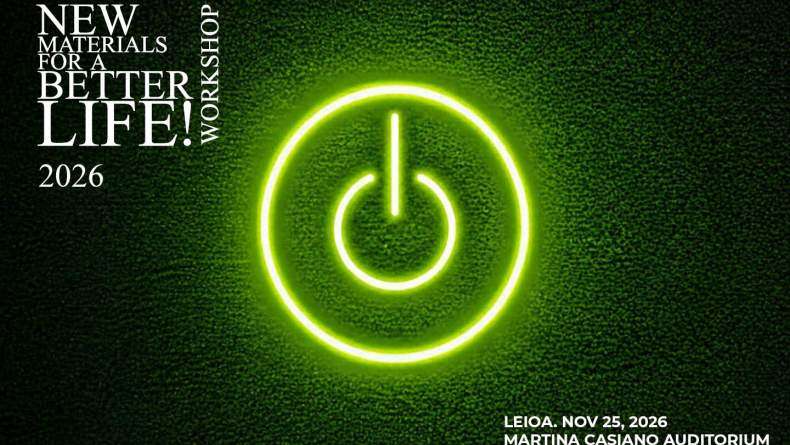
BCMaterials’ Annual Workshop Puts Catalysis for the Green Transition in the Spotlight
BCMaterials, the Basque Center for Materials, Applications and Nanostructures, will hold the new edition of its annual workshop “New Materials for a Better Life” on Wednesday, 25 November 2026, from…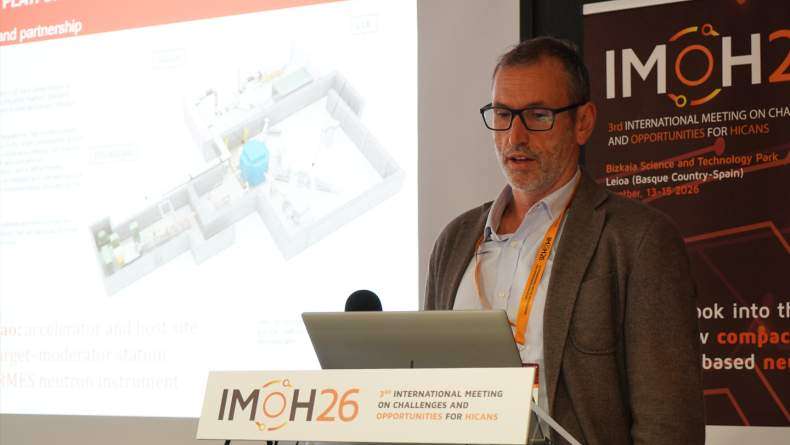
IMoH 2026 Brings the International Compact Neutron Source Community Together at BCMaterials
Around one hundred neutron science specialists from a dozen countries in Europe and North America met in Leioa from 13 to 15 October for the third edition of the International Meeting on Challenges…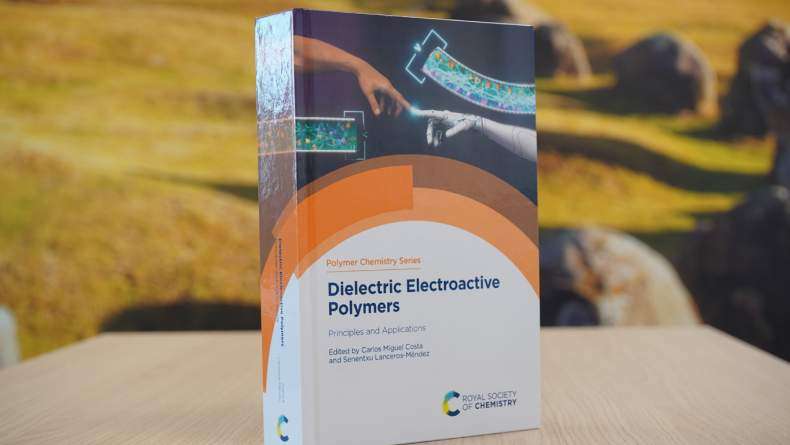
New BCMaterials book on advances in dielectric electroactive polymers
The Royal Society of Chemistry has published “Dielectric Electroactive Polymers: Principles and Applications”, a volume co-edited by Senentxu Lanceros-Méndez, Scientific Director of BCMaterials, and…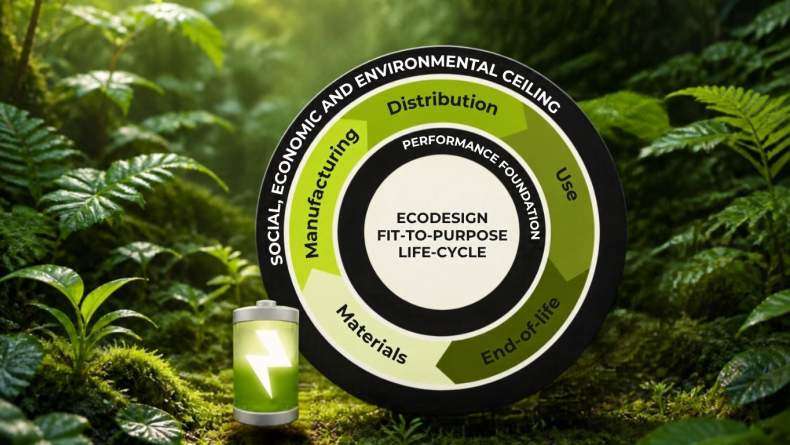
New Article in Zientzia Kaiera: Portable Batteries that Respect Planetary Limits
Digitalisation has shortened the lifespan of devices and driven up electronic waste: 53.6 million tonnes in 2019, according to the United Nations, with 110 million forecast for 2050. Only 17.4% of…