
BCMaterials Fortnightly Seminars #15

“Shape Memory Polymers: gamma irradiated polycyclooctene”
Nuria García-Huete(BCMaterials)
Gamma radiation process for modification of commercial polymers is a widely applied technique to promote new physical, chemical and mechanical properties. Gamma irradiation originates free radicals able to induce chain scission or recombination of radicals, which can induce, for example, crosslinking processes. The aim of this work is to research the structural, thermal and mechanical changes induced on a commercial polycyclooctene (PCO) when it is irradiated with a gamma source of 60Co at different doses (25-200 kGy). After gamma irradiation, gel content was determined by Soxhlet extraction in cyclohexane. Furthermore, thermal properties were evaluated before and after Soxhlet extraction by means of Thermogravimetric Analysis (TGA) and Differential Scanning Calorimetry (DSC), as well as mechanical properties were measured by Dynamic Mechanical Thermal Analysis (DMTA). The results showed the variations of the properties depending on the irradiation dose. Finally, a first approach to evaluate qualitatively the shape memory behaviour of all irradiated PCO samples was performed by visually monitoring shape recovery process. “Shedding light on the origin of multiferroicity in Mn1-xCoxWO4” Irene Urcelay-Olabarria(BCMaterials)
The use of the superspace symmetry analysis allows to rationalize the physical properties induced by incommensurate magnetic structure (ICMS) [1]. The ICMS of the type II Mn1-xCoxWO4 multiferroics have been studied in the light of this formalism. MnWO4 is a multiferroic material in which the magnetic order of one of its magnetic phases induces ferroelectricity. Like most multiferroic materials MnWO4 is extremely sensitive to small perturbations such as chemical substitution. It turned out that doping with Co2+ is particularly interesting since it strongly stabilizes the multiferroic phase at low temperatures, and moreover, by increasing the cobalt amount in the crystals (x>0.075) the orientation of the electric polarization flops from the b axis to the ac plane [2,3]. This change of orientation is linked to the symmetry change. The ICMS of x = 0 and x = 0.10 compounds, which exhibit completely different behavior, have been studied thoroughly using superspace formalism. We have found, not only the symmetry of the magnetic structures and their intrinsic restrictions, but also information about the tensor properties of each incommensurate phase, such as ferroelectricity or magnetostructural properties [4] of both compounds.Related news
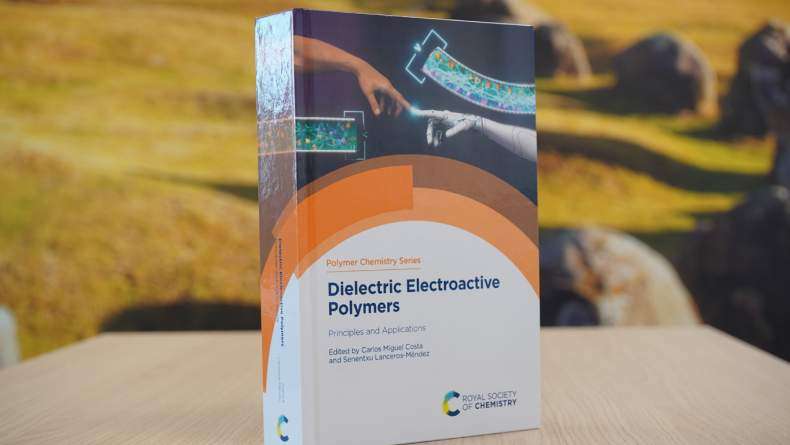
New BCMaterials book on advances in dielectric electroactive polymers
The Royal Society of Chemistry has published “Dielectric Electroactive Polymers: Principles and Applications”, a volume co-edited by Senentxu Lanceros-Méndez, Scientific Director of BCMaterials, and…
New Article in Zientzia Kaiera: Portable Batteries that Respect Planetary Limits
Digitalisation has shortened the lifespan of devices and driven up electronic waste: 53.6 million tonnes in 2019, according to the United Nations, with 110 million forecast for 2050. Only 17.4% of…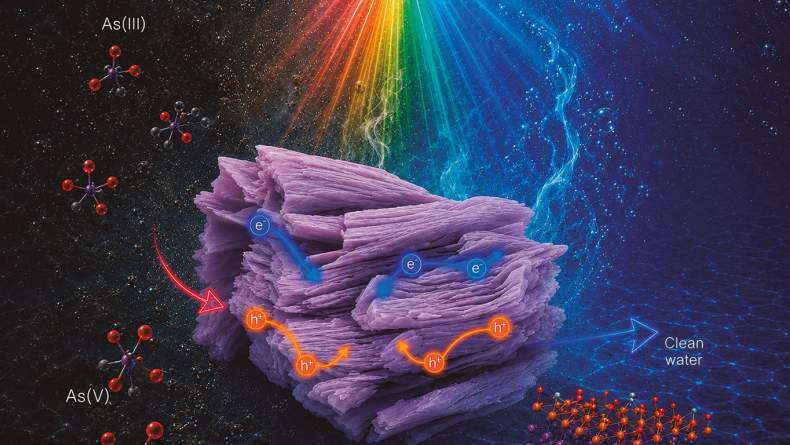
BCMaterials Research Earns Front Cover of Journal of Materials Chemistry A
A study led by BCMaterials researcher Maibelin Rosales, together with Senentxu Lanceros-Méndez, Javier del Campo, and Jorge Saiz, has been published in Journal of Materials Chemistry A and featured…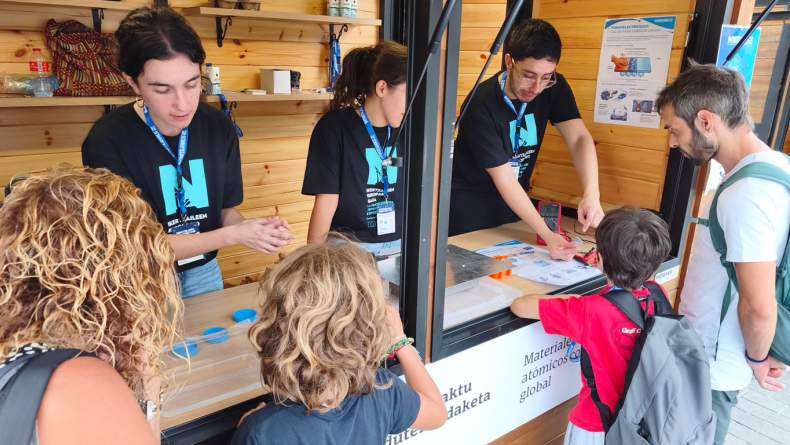
Science and Fun at Bilbao’s European Researchers’ Night
On 25 September, BCMaterials took part in a new edition of the European Researchers’ Night, organised by the University of the Basque Country at El Arenal in Bilbao. Through a series of fun…