
BCMaterials talk at Universite? de Versailles Saint-Quentin-en-Yvelines – CNRS
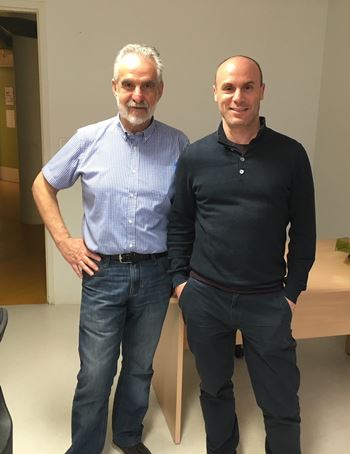
[caption id="attachment_21134" align="alignright" width="279"] Manu Barandiaran and David Schmool, Director of the Groupe d'étude de la matière condensée (GEMaC)[/caption]
Manu Barandiaran , former director of BCMaterials, was on past week at the Université de Versailles Saint-Quentin-en-Yvelines – CNRS, talking about Magnetic Materials research at BCMaterials.
Magnetic shape memory alloys (MSMAs), such as the Heusler compound Ni2MnGa and off-stoichiometric alloys, couple the martensitic transformation (MT) with ferromagnetism, enabling outstanding effects like magnetically induced strains, up to 12%, high frequency response and large power density, of great interest for magnetic actuators. Some other MSMA, as Ni-Mn-X (X=In, Sn, Sb), also display large magnetocaloric and magnetoresistance effects, with possible applications in magnetic refrigeration, sensors, etc. A review of recent work on these alloys is presented, for bulk and single crystal as well as thin films and nanopillars. The later provide promising evidence for thermal and magnetic actuation at the nanoscale.
Search for alternatives to current available materials, which do not contain critical elements as Rare Earths (RE), is a priority in the European Union and worldwide. Some recent results on lean or no RE containing compounds for high energy Permanent Magnets will be also presented. This work is part of the ongoing EU H2020 project: Novel, critical materials free, high anisotropy phases for permanent magnets, by design
Manu Barandiaran and David Schmool, Director of the Groupe d'étude de la matière condensée (GEMaC)[/caption]
Manu Barandiaran , former director of BCMaterials, was on past week at the Université de Versailles Saint-Quentin-en-Yvelines – CNRS, talking about Magnetic Materials research at BCMaterials.
Magnetic shape memory alloys (MSMAs), such as the Heusler compound Ni2MnGa and off-stoichiometric alloys, couple the martensitic transformation (MT) with ferromagnetism, enabling outstanding effects like magnetically induced strains, up to 12%, high frequency response and large power density, of great interest for magnetic actuators. Some other MSMA, as Ni-Mn-X (X=In, Sn, Sb), also display large magnetocaloric and magnetoresistance effects, with possible applications in magnetic refrigeration, sensors, etc. A review of recent work on these alloys is presented, for bulk and single crystal as well as thin films and nanopillars. The later provide promising evidence for thermal and magnetic actuation at the nanoscale.
Search for alternatives to current available materials, which do not contain critical elements as Rare Earths (RE), is a priority in the European Union and worldwide. Some recent results on lean or no RE containing compounds for high energy Permanent Magnets will be also presented. This work is part of the ongoing EU H2020 project: Novel, critical materials free, high anisotropy phases for permanent magnets, by design
Manu Barandiaran and David Schmool, Director of the Groupe d'étude de la matière condensée (GEMaC)[/caption]
Manu Barandiaran , former director of BCMaterials, was on past week at the Université de Versailles Saint-Quentin-en-Yvelines – CNRS, talking about Magnetic Materials research at BCMaterials.
Magnetic shape memory alloys (MSMAs), such as the Heusler compound Ni2MnGa and off-stoichiometric alloys, couple the martensitic transformation (MT) with ferromagnetism, enabling outstanding effects like magnetically induced strains, up to 12%, high frequency response and large power density, of great interest for magnetic actuators. Some other MSMA, as Ni-Mn-X (X=In, Sn, Sb), also display large magnetocaloric and magnetoresistance effects, with possible applications in magnetic refrigeration, sensors, etc. A review of recent work on these alloys is presented, for bulk and single crystal as well as thin films and nanopillars. The later provide promising evidence for thermal and magnetic actuation at the nanoscale.
Search for alternatives to current available materials, which do not contain critical elements as Rare Earths (RE), is a priority in the European Union and worldwide. Some recent results on lean or no RE containing compounds for high energy Permanent Magnets will be also presented. This work is part of the ongoing EU H2020 project: Novel, critical materials free, high anisotropy phases for permanent magnets, by designRelated news
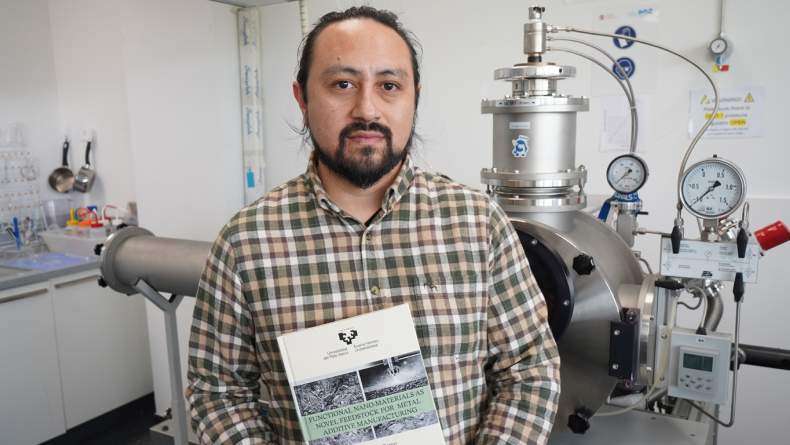
James Rosero, New Doctor of BCMaterials
We would like to congratulate James Rosero for obtaining his PhDs in Materials Science and Technology from the University of the Basque Country (UPV/EHU). On February 27 he made a brilliant defense…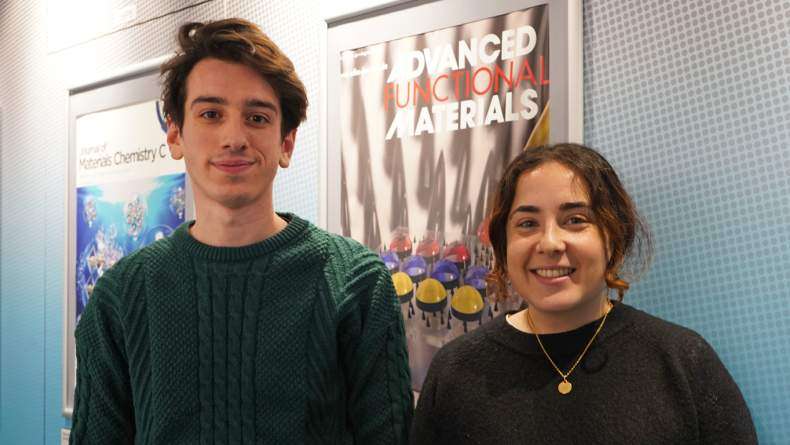
Sara Martín and Stefano Lunghi Join BCMaterials as New Researchers
BCMaterials is pleased to welcome two new members to its research team: Sara Martín Iglesias, a postdoctoral researcher in the Active and Smart Materials research line, and Stefano Lunghi, a…
Nanomaterials for Water Remediation and Valorization
Scientific staff at BCMaterials are developing next-generation nanomaterials combined with naturally sourced polymer membranes for water decontamination and reuse. These advanced materials not only…
Three New Resarchers Join BCMaterials
The new year has brought BCMaterials the arrival of three new young scientists to our staff. They are the pre-doctoral researchers Karen Cano and Mikel Russo, along with the post-doctoral researcher…