
BCMaterials oral presentation @ 5th Zing Bionanomaterials Conference
Meet our researchers at 5th Zing Bionanomaterials Conference on April 26th (11:50) in Algarve (Portugal), and learn about our latest Bio&Med advances contacting Maite Goiriena.
Permalloy nanodisks prepared by Colloidal Lithography for Biomedical Applications


M. Goiriena-Goikoetxea1, A. García-Arribas1,2, A. Svalov2 and M.L. Fdez-Gubieda1,2
1 BCMaterials, UPV/EHU, Barrio de Sarriena s/n, 48940, Leioa, Spain. 2 Departamento de Electricidad y Electrónica, UPV/EHU, Barrio de Sarriena s/n, 48940, Leioa, Spain. maite.goiriena@bcmaterials.net
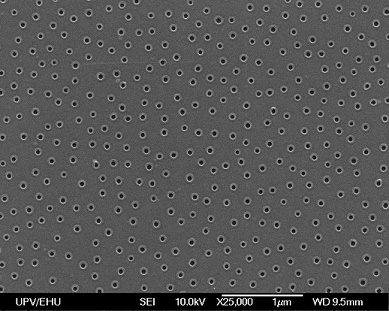
Magnetic nanoparticles are extensively studied for biomedical applications because their size are comparable to biological entities, while providing remote capabilities of actuation1. Disk shaped ferromagnetic nanoparticles add attractive possibilities to these characteristics. First, Permalloy (Py) nanodisks display much higher saturation magnetization values than oxide nanoparticles and second, they can present a spin vortex configuration which leads to net zero magnetization at remanence, eliminating the problem of particle agglomeration. Therefore, Py nanodisks present a huge potential for biomedical applications, ranging from cancer cell destroy by hyperthermia or mechanical actuation (a low AC field makes the disk to oscillate damaging cell membrane and triggering the apoptosis) to MRI contrast enhancement and drug delivery2. Furthermore, we propose that nanodisks might cross cell membrane expanding the biomedical possibilities. While oxide nanoparticles are chemically synthetized, nanodisks physical fabrication methods offer higher control on particle size and geometry and the possibility of choosing among a larger spectrum of materials, i.e. electron beam lithography (EBL) and photolithography. These techniques, though, imply a very low yield production (in the case of EBL) and the use of sophisticated and expensive equipment. As an alternative, self-assembling routes provide high volume and low cost production of Py nanodisks. In this work we present the results obtained by Hole-mask Colloidal Lithography (HCL3). HCL utilizes the definition of a dense hole-pattern in a sacrificial resist layer onto which a layer of Py is deposited. Py disks with different sizes are produced after lift-off of the resist layer. The results obtained show promising structures. The magnetic characterization performed by Magneto-Optical Kerr Effect (MOKE) indicates that vortex-state is present4. The release of the nanodisks from the substrate is being optimized at this moment, with the consequent biofunctionalization and in vitro assays. 1 Q. A. Pankhurst et al., Journal of Physics D: Applied Physics, 2003, 167. 2 D.-H. Kim, et. al., Nature Materials, 2009, 9, 165. 3 Fredriksson et al., Advanced Materials, 2007, 19, 4297. 4 G. Shimon et al., Physical Review B, 2013, 87, 214422. [su_row][su_column size="1/2"]Figure 1 : hole-patterned resist.
[/su_column][su_column size="1/2"]Figure 2 : Permalloy nanodisks on SiO2 substrate.
[/su_column][/su_row] You can download the conference programme here.Related news
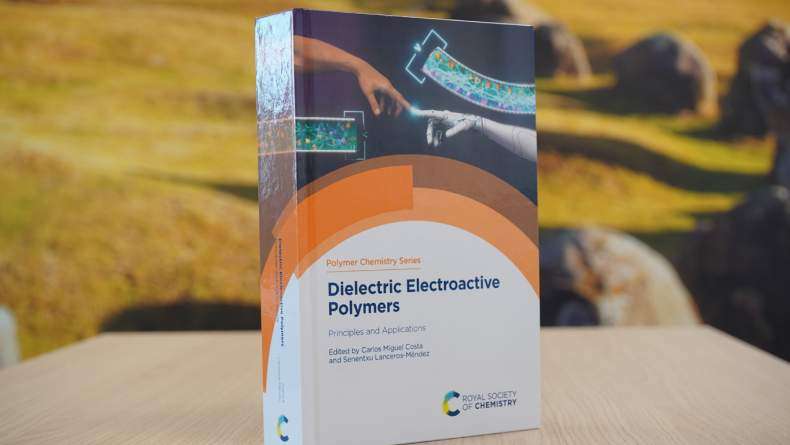
New BCMaterials book on advances in dielectric electroactive polymers
The Royal Society of Chemistry has published “Dielectric Electroactive Polymers: Principles and Applications”, a volume co-edited by Senentxu Lanceros-Méndez, Scientific Director of BCMaterials, and…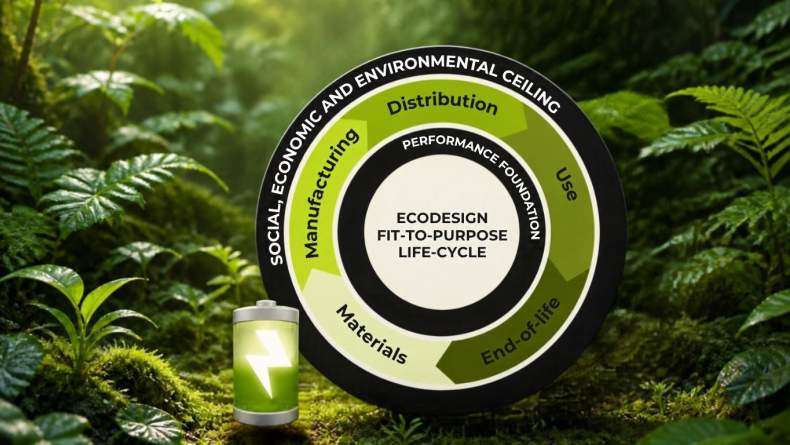
New Article in Zientzia Kaiera: Portable Batteries that Respect Planetary Limits
Digitalisation has shortened the lifespan of devices and driven up electronic waste: 53.6 million tonnes in 2019, according to the United Nations, with 110 million forecast for 2050. Only 17.4% of…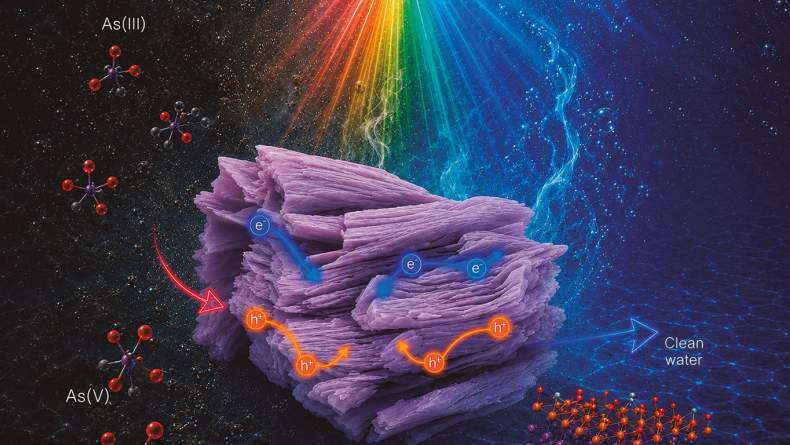
BCMaterials Research Earns Front Cover of Journal of Materials Chemistry A
A study led by BCMaterials researcher Maibelin Rosales, together with Senentxu Lanceros-Méndez, Javier del Campo, and Jorge Saiz, has been published in Journal of Materials Chemistry A and featured…
Science and Fun at Bilbao’s European Researchers’ Night
On 25 September, BCMaterials took part in a new edition of the European Researchers’ Night, organised by the University of the Basque Country at El Arenal in Bilbao. Through a series of fun…