
BCMaterials Fortnightly Seminar #49: Ariane Sagasti and Andrés Martin

ARIANE SAGASTI
(BCMATERIALS)
MAGNETOELASTIC RESONATOR FOR HIGHLY SPECIFIC CHEMICAL AND BIOLOGICAL DETECTION: A CRITICAL STUDY
We have developed a detection system made of an amorphous ferromagnetic ribbon of composition Fe64Co17Si6.6B12.4, with excellent magnetoelastic properties as saturation magnetostriction of 23 ppm and DE effect of 27%. The resonators were coated with polystyrene (PS). Consecutive depositions were applied by dip coating from 10 to 100 µM solution in tetrahydrofuran (THF). The mass increment after each deposition was accurately measured with a high precision (0,1µg) balance, and compared with the corresponding resonant frequency. We have tested resonators with L=3, 2 and 1 cm length. As theory predicts, we have observed a decrease on that resonant frequency as the PS mass increases, reaching a maximum sensitivity of S=Df/Dm=54,9 Hz/µg (that corresponds to 18 ng detection for 1 Hz resolution), for the 1 cm length resonator. Nevertheless, our measurements show even better results than theoretically predicted by the common resonator model. Bearing this in mind, here we present a critical study on the conditions for an optimum performance of such resonance-based sensing devices, both from the point of view of the magnetoelastic resonance conditions and from the layer deposition procedure.
ANDRES MARTIN
(BCMATERIALS)
TETRAGONAL CE-BASED CE-SM(FE,CO,TI)12 ALLOYS FOR PERMANENT MAGNETS
Rare-earth intermetallic compounds with composition R(Fe,Co)12 crystallize into a tetragonal structure of the type ThMn12 with uniaxial anisotropy. This structure is stabilized with the addition of a non-magnetic element (Mo,Ti,V...) that leads to lower values of magnetization. Among these materials the Ce-based compounds have been very attractive recently because of the low cost of Ce which is much more abundant than the other rare earths. In this work, we have studied the magnetic and structural properties of Sm1-xCexFe9Co2Ti ribbons (x=1, 0.75, 0.5, 0.25) melt-spun with wheel speed of 15 m/s and 35 m/s. The melt-spun samples were annealed at temperatures in the 700-800 oC range to obtain the desired 1:12 tetragonal phase with optimum hard magnetic properties. The Sm-free CeFe9Co2Ti samples spun at 35 m/s showed a negligible coercivity suggesting that they are amorphous while the ones spun at 15 m/s show a smooth hysteresis loop with a coercivity of 540 Oe. On the other hand, the Ce.5Sm.5Fe9Co2Ti samples spun at wheel speed 15 m/s show a smooth hysteresis loop with a coercivity of 1404 Oe as compared to the samples spun at higher speeds which show a constricted loop suggesting a decoupled mixture of soft and hard phases, which were identified by x-ray diffraction as bcc-Fe and 1:12 tetragonal phases, respectively. Annealing at 700 oC was found to increase the coercivity substantially with maximum values of 778 Oe for the former and 2010 Oe for the latter compositions.
Related news
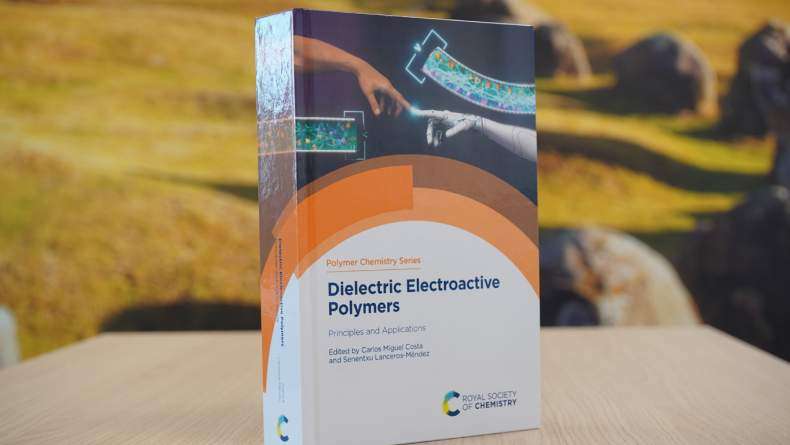
New BCMaterials book on advances in dielectric electroactive polymers
The Royal Society of Chemistry has published “Dielectric Electroactive Polymers: Principles and Applications”, a volume co-edited by Senentxu Lanceros-Méndez, Scientific Director of BCMaterials, and…
New Article in Zientzia Kaiera: Portable Batteries that Respect Planetary Limits
Digitalisation has shortened the lifespan of devices and driven up electronic waste: 53.6 million tonnes in 2019, according to the United Nations, with 110 million forecast for 2050. Only 17.4% of…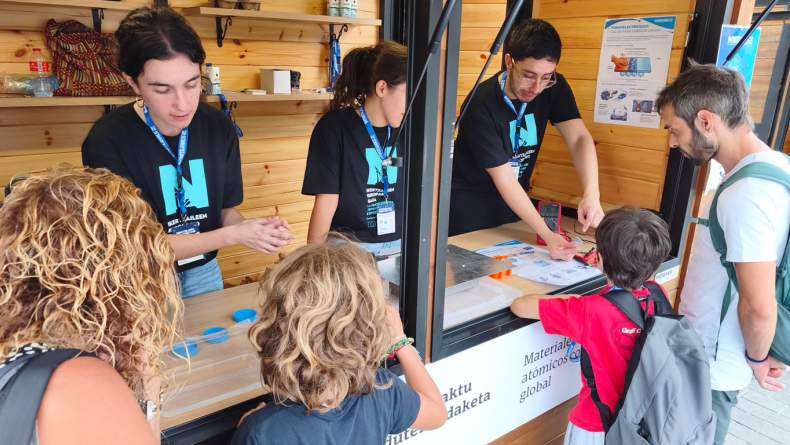
Science and Fun at Bilbao’s European Researchers’ Night
On 25 September, BCMaterials took part in a new edition of the European Researchers’ Night, organised by the University of the Basque Country at El Arenal in Bilbao. Through a series of fun…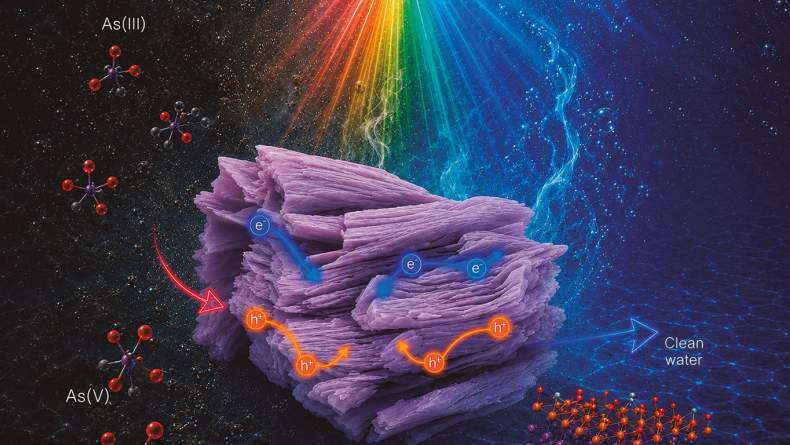
BCMaterials Research Earns Front Cover of Journal of Materials Chemistry A
A study led by BCMaterials researcher Maibelin Rosales, together with Senentxu Lanceros-Méndez, Javier del Campo, and Jorge Saiz, has been published in Journal of Materials Chemistry A and featured…