
BCMaterials Fortnightly Seminar #90 Eduardo Fernández - Arkaitz Fidalgo

EDUARDO FERNÁNDEZ
(BCMATERIALS)
Magnetoimpedance strain gage sensors on FeNi alloys
I. INTRODUCTION The magneto-impedance (MI) effect accounts for the large change of the electrical impedance experienced by soft magnetic materials when a magnetic field modifies its magnetic permeability by external agents, such as magnetic field, stress or temperature. Due to the skin effect, there is a limited penetration of the electromagnetic field associated with an alternating current flowing through the material. The skin effect reduces the effective cross section available for the ac current to flow and consequently the impedance depends on the external agents. In previous studies, we have systematically optimized the preparation conditions, structure and combination of shape and induced anisotropies to enhance the MI ratios and sensitivities on Ni80Fe20 multilayers [1-3]. In this work, we explore the route of using MI as strain gage sensors depositing them onto flexible substrates. This option has already been marginally explored [4-6], but not in materials with relative large magnetostrictive coefficient as Fe60Ni40 [7] and reasonable MI ratios.
II. STRUCTURE AND PREPARATION OF MULTILAYERED SAMPLES Sputtered Iron-Nickel based thin films lose their magnetic softness when the thickness is increased above the critical one (typically about 200 nm) [1,7]. Iron-Nickel films below that limit display excellent magnetic properties with slight differences below 100 nm films [2]. If nanometric non-magnetic spacers are inserted between two consecutive magnetic layers, thicker magnetically soft multilayer structures can be obtained [3]. We have therefore selected the [Fe100 xNix(100 nm)/Ti(6 nm)]2/Cu(200 nm)/[Ti(6 nm)/Fe100-xNix(100 nm)]2 multilayered structure for fabrication of two series of the samples, with x=80 and 40. The two sets of samples were prepared using metallic masks during the sputtering to obtain elongated stripe shaped samples of 10 mm long and 0.5 mm wide. Square Cu pads were deposited at the stripe’s ends for electrical contacts. For comparison, the samples were deposited simultaneously on Silicon, Cyclic olefin copolymer (COC) and Kapton® polyimide film. The samples were prepared by DC sputtering under a magnetic field oriented in a transverse direction to the stripe length inducing a transverse magnetic anisotropy. Being this field 250 Oe for Ni80Fe20 and 500 Oe for Fe60Ni40.
III. MEASUREMENTS AND RESULTS Samples were magnetically characterized by measuring the hysteresis loops with a Vibrating Sample Magnetometer (VSM). Figure 1 show the typical hysteresis loops, displaying a well define transverse magnetic anisotropy of 5 Oe, but with larger coercivity in the samples deposited onto flexible substrates. The impedance was extracted from the reflection coefficient measured using a network analyzer. To determine the stress-impedance characteristics of the MI material deposited onto the flexible substrates, a custom sample holder was designed as describe in [4,5]. The samples are glued to a miscrsotrip line together with a commercial resistive strain gage, closely situated to the sample and experiencing the same deformation. At the same time that the stress is applied, the hysteresis loops is measured using the magneto-optical Kerr effect (MOKE) while measuring the impedance as function of the applied magnetic field. As shown in figure 2, the sample deposited on Silicon shows a maximum MI ratio, calculated for the absolute value of the impedance Z as MI(%) = (Z-Zmin)/Zmin 100, of 80% at 70 MHz and a sensitivity, defined as the derivative of the MI ratio, of 25 %/Oe.
ARKAITZ FIDALGO
(BCMATERIALS)
Proton conduction with metaloporphyrinic Metal-Organic Frameworks
MOF type materials show great potential for a wide range of applications due to their high porosity, low density and ease of structural modification. In particular, MOFs based on metalloporphyrins are becoming very important in many fields. These materials are inspired by the biological functions of these natural macrocycles coordinated to metal ions. On the other hand, recently, proton conductive materials have aroused great interest, and those with high conductivity values are potential candidates to play a key role in some solid-state electrochemical devices, such as batteries and fuel cells.
In this way, using metalloporphyrins we have obtained a new crystalline material with formula [H(bipy)2][MnTPPS)(H2O)2]·2bipy·14H2O, where bipy is 4,4'-bipyridine and TPPS meso-tetra (4-sulfonatophenyl) porphyrin. The crystal structure was determined by single-crystal X-ray diffraction and the thermal characterization was carried out by means of thermogravimetric measurements (TG/DSC) and X-ray thermodifraction (XRTD). The compound shows a zig-zag water chain along the [100] direction located between the sulfonate groups of the porphyrin. Taking into account these structural characteristics, the compound was tested for proton conduction obtaining very good results (1x10⁻² S·cm-1) at 40 °C and 98% relative humidity.
Related news
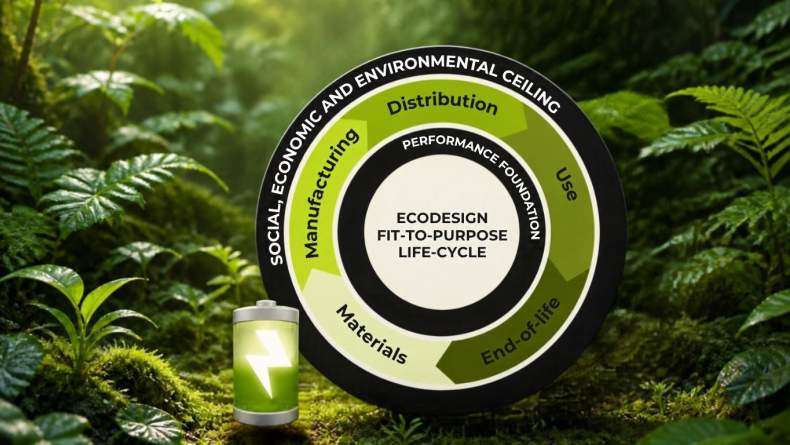
New Article in Zientzia Kaiera: Portable Batteries that Respect Planetary Limits
Digitalisation has shortened the lifespan of devices and driven up electronic waste: 53.6 million tonnes in 2019, according to the United Nations, with 110 million forecast for 2050. Only 17.4% of…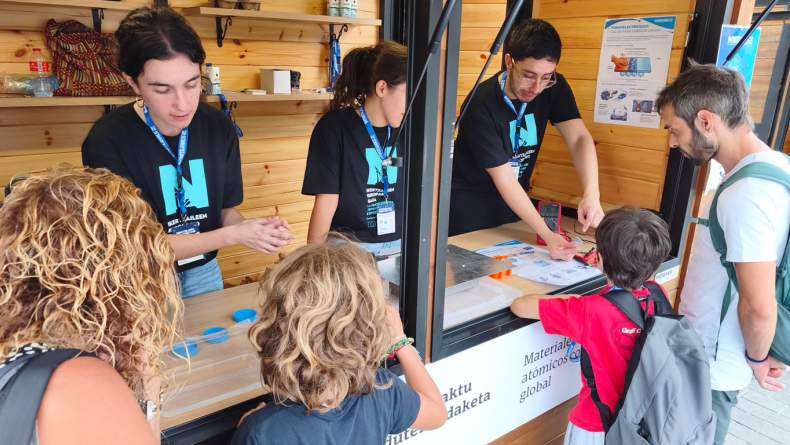
Science and Fun at Bilbao’s European Researchers’ Night
On 25 September, BCMaterials took part in a new edition of the European Researchers’ Night, organised by the University of the Basque Country at El Arenal in Bilbao. Through a series of fun…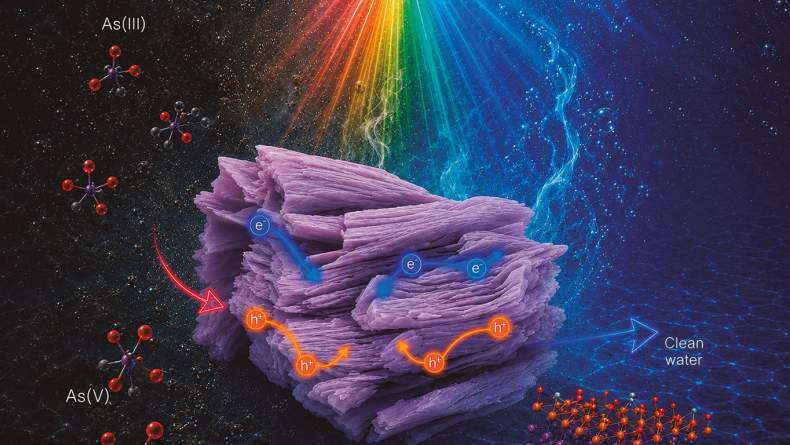
BCMaterials Research Earns Front Cover of Journal of Materials Chemistry A
A study led by BCMaterials researcher Maibelin Rosales, together with Senentxu Lanceros-Méndez, Javier del Campo, and Jorge Saiz, has been published in Journal of Materials Chemistry A and featured…
Invited Talk by Franck Dumeignil on Biorefineries (October 1)
On October 1, Franck Dumeignil, Full Professor at the University of Lille (France), will give an invited talk at BCMaterials entitled 'An Overview of Biorefineries'. The lecture will take place in…