
BCMaterials Fortnightly Seminar #70: Daniel Salazar
DANIEL SALAZAR
(BCMATERIALS)
Tuning hysteresis in metamagnetic shape memory alloys for refrigeration applications
One of the challenges of modern societies consists in to increase the equipment energy efficiency, with the aim of reducing the energy consumption. In this sense, the magnetic refrigeration, a solid-state technology based in the magnetocaloric effect (MCE), attracts large interest because it is considered a feasible substitute of the conventional air-compressed refrigerant systems due to, among other advantages, its superior efficiency (of up to 60% of Carnot's cycle). However, to be commercially engaging, this technology still needs cheap materials with enhanced refrigerant properties. Among the studied materials, metamagnetic shape memory alloys-MSMA (mainly, Heusler-type Ni-Mn-based alloys) represent a new kind of multifunctional (smart) materials which develop exotic properties as magneto-deformation effect, giant magnetoresistance and inverse magnetocaloric effect as a consequence of a magneto-structural transformation [1]. These technologically relevant properties are strongly related to magnetic and structural instabilities and are due to a decrease of ferromagnetism induced by martensitic transformation (MT).
Recent results of the magnetic properties and the direct measurement of the MCE obtained in MSMA are presented in this work. In order to have a wide view of the mechanisms that affect the MCE response, several NiMnIn-based MSMA were studied in bulk and in ribbon shape, analysing the magnetocaloric response associated to the MT and the magnetic phase transition in the austenite phase by estimating the magnetic entropy change, ∆SM, from magnetization measurements, and measuring directly the adiabatic temperature change, ∆Tad. [2].
References- Álvarez-Alonso, C.O. Aguilar-Ortiz, J.P. Camarillo, D. Salazar, H. Flores-Zuñiga,, V.A. Chernenko, App. Phys. Lett. 109 (2016) 212402.
- Álvarez-Alonso, J. López-García, G. Daniel-Perez, D. Salazar, P. Lázpita, J.P. Camarillo, H. Flores-Zuñiga, D. Rios-Jara, J.L. Sánchez-Llamazares, and V.A. Chernenko, Key Eng. Mater. 644 (2015) 215.
Related news
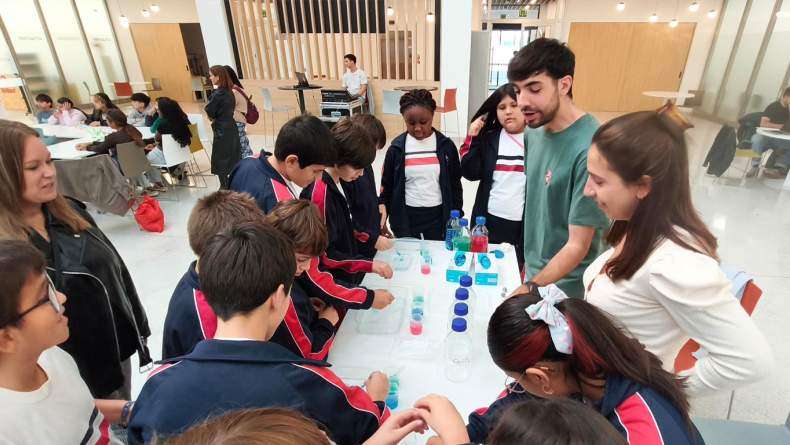
BCMaterialsek MOFak eta hidrogelak eraman zituen BeZientzia 2026 zientzia-azokara
BCMaterialsek BeZientzia zientzia-azokan hartu zuen parte urriaren 26an eta 27an. Azoka Bilboko Ensanche eraikinean egin zen, eta Bizkaiko bost BERC zentroak bildu zituen: Achucarro, BC3, BCAM,…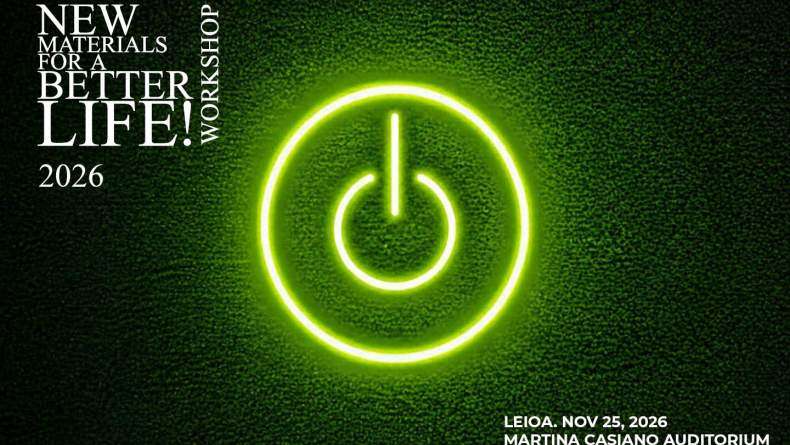
BCMaterialsen urteko workshopak trantsizio berderako katalisia jarriko du erdigunean
BCMaterials, Basque Center for Materials, Applications and Nanostructures zentroak, urteko workshoparen edizio berria egingo du: “New Materials for a Better Life”. 2026ko azaroaren 25ean, asteazkena…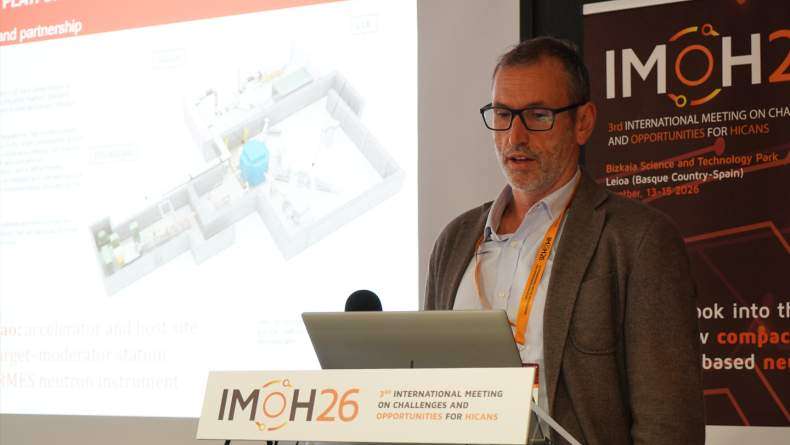
IMoH 2026-k neutroi-iturri trinkoen nazioarteko komunitatea bildu du BCMaterialsen
Neutroien zientziako ehun bat espezialista inguru, Europako eta Ipar Amerikako hamabi bat herrialdetatik etorriak, bildu ziren Leioan urriaren 13tik 15era, International Meeting on Challenges and…
BCMaterials-en liburu berri batek polimero elektroaktibo dielektrikoen inguruan
Royal Society of Chemistry argitaletxeak “Dielectric Electroactive Polymers: Principles and Applications” liburua argitaratu du, Polymer Chemistry Series bildumaren barruan. BCMaterialseko zuzendari…