
BCMaterials Fortnightly Seminars #28
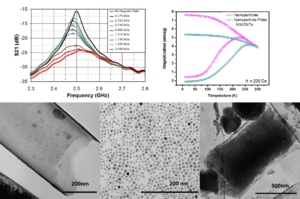
"Magnetically Tunable RF and Microwave Polymer Nanocomposite Materials"
KRISTEN STOJAK
(University of South Florida)
We have fabricated and studied a class of polymer nanocomposite (PNC) materials incorporating magnetic nanoparticles into various polymers. There has been much interest in these magnetic PNCs due to potential applications for EMI shielding, tunable electromagnetic devices and flexible electronics. The resonance frequency can be tuned in these PNCs in the presence of an externally applied magnetic field, via the inversely proportional relationship between the resonance frequency and the product of relative permittivity (εr) and permeability (μr). As the frequency is swept, εr of a dielectric material changes and as the magnetic field is swept, μr of a magnetic material changes. We have also recently developed a novel class of one-dimensional magnetic nanostructures composed of multi-walled carbon nanotubes (MWCNTs) filled with magnetic nanoparticles. Studies determined that the magnetic properties of the nanoparticles become enhanced when confined within MWCNTs, as evidenced strongly by change in relaxation time, higher characteristic temperature and higher blocking temperature from standard DC and AC magnetometry.
By incorporating magnetically tunable PNCs in to a microwave or RF device, we are able to determine and appropriately tune the resonance characteristics for that device to cater them for desired applications depending on the type of magnetic filler material used. This would lead to a wider range of possible wireless communications devices to be developed and optimized with relative ease and low-cost.
We have also recently developed a novel class of one-dimensional magnetic nanostructures composed of multi-walled carbon nanotubes (MWCNTs) filled with magnetic nanoparticles. Studies determined that the magnetic properties of the nanoparticles become enhanced when confined within MWCNTs, as evidenced strongly by change in relaxation time, higher characteristic temperature and higher blocking temperature from standard DC and AC magnetometry.
By incorporating magnetically tunable PNCs in to a microwave or RF device, we are able to determine and appropriately tune the resonance characteristics for that device to cater them for desired applications depending on the type of magnetic filler material used. This would lead to a wider range of possible wireless communications devices to be developed and optimized with relative ease and low-cost.
“Fabrication and Study of Static and Dynamic Characteristics of Metal-Ferroelectric-Metal Nanoscale Film Capacitor Structures”
HOVHANDA DASHTOYAN
(National Polytechnic University of Armenia)
In order to meet the strict requirements of modern information systems materials and structures with new and improved features are needed. In this regard the structures based on ferroelectrics (FEs) have a great potential. Interest in FE thin films has been considerable over the last 20 years, driven by the possibility of using them for non-volatile memory applications and new microelectromechanical systems (MEMS), FE FETs, photosensitive bio-medical sensors, solid-oxide fuel cell (SOFC) electrodes, voltage-tunable capacitors, microwave electronic components, Film Bulk Acoustic Wave Resonators [1-3], etc. We have already investigated methods of fabrication of FE based (Ba0.25Sr0.75TiO3, Ba0.31Sr0.69TiO3, ZnO) nanoscale film capacitor structures [4, 5], their dark and photo J(V), I(V) characteristics, charge transport and conduction mechanisms in FE thin films, etc. in the framework of my PhD thesis. In the framework of ERASMUS MUNDUS BACKIS grant program at the UPV/EHU it is planned to fabricate diverse FE based thin film capacitor structures (mainly metal-ferroelectric-metal) and develop the efficient technologies of fabrication, experimentally investigate different static and dynamic characteristics of fabricated structures and compare these results with the theory already developed by our research group in the framework of my PhD thesis.Related news
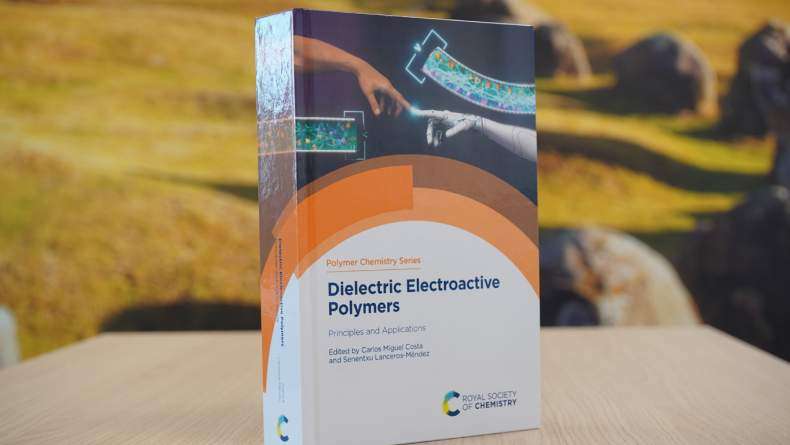
Nuevo libro de BCMaterials sobre avances en polímeros electroactivos dieléctricos
La Royal Society of Chemistry ha publicado "Dielectric Electroactive Polymers: Principles and Applications", un volumen coeditado por Senentxu Lanceros-Méndez, director científico de BCMaterials, y...
Nuevo artículo en Zientzia Kaiera: baterías portátiles respetuosas con los límites del planeta
La digitalización ha acortado la vida útil de los dispositivos y ha disparado los residuos electrónicos: 53,6 millones de toneladas en 2019, según Naciones Unidas, con una previsión de 110 millones...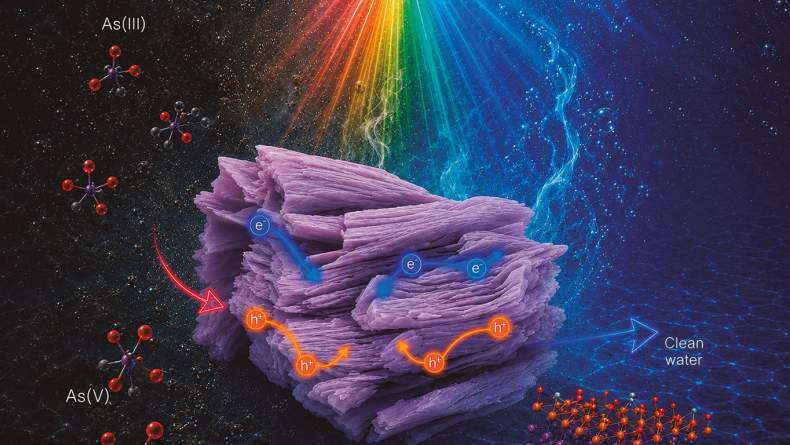
La investigación de BCMaterials, portada de Journal of Materials Chemistry A
Un estudio liderado por la investigadora de BCMaterials Maibelin Rosales, junto con Senentxu Lanceros-Méndez, Javier del Campo y Jorge Saiz, ha sido publicado en la revista Journal of Materials...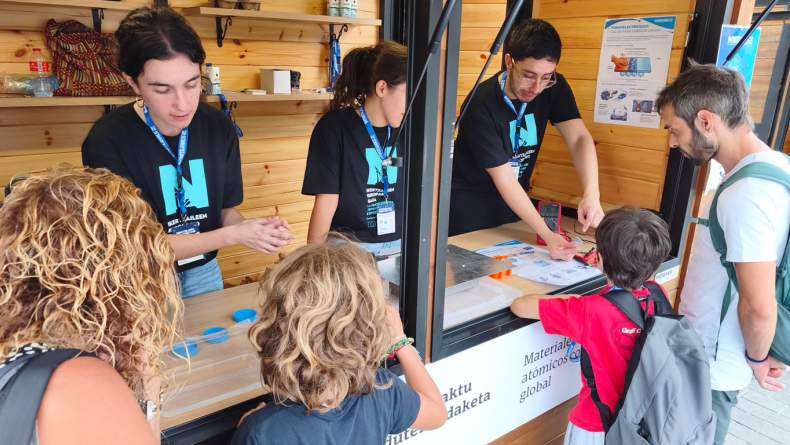
Ciencia y diversión en la Noche Europea de los Investigadores e Investigadoras de Bilbao
El pasado 25 de septiembre, BCMaterials participó en una nueva edición de la Noche Europea de los Investigadores e Investigadoras, organizada por la Universidad del País Vasco en El Arenal de Bilbao...