
BCMaterials Fortnightly Seminar #47: Iker Lamas and Lourdes Marcano

IKER LAMAS
(BCMATERIALS)
PREPARATION OF METAL AND SEMICONDUCTOR NANOSTRUCTURES FOR ENHANCEMENT OF PLASMONIC DYE-SENSITIZED SOLAR CELLS PERFORMANCE:
In the last decade, dye-sensitized solar cells (DSSCs) have received much attention because of their attractive properties although much work is required to reach optimal device efficiencies. In this Master´s Thesis different nanostructures have been synthesized in order to enhance the efficiency of DSSCs with TiO2 photoanodes. For that purpose, TiO2 nanoparticulated mesoporous xerogels have been synthesized from aqueous solution using molecular atrane complexes as precursors. Two kind of semiconductors have been synthesized, one using a surfactant-free strategy (UVM-11) and another one using it (UVM-7). Also, Ag and Au core@shell nanorods have been prepared and its coupling effects on the performance of DSSCs have been investigated by absorption and emission (fluorescence) UV-Vis-NIR spectroscopy and high temperature electrochemical impedance spectroscopy. Despite the fact that we couldn´t demonstrate if there is an energy transfer process between localized surface plasmon resonance band of NRs and conduction bands of semiconductor, we determinate that Au@Au NRs are a promising alternative to achieve a higher photocurrent and power conversion efficiency.LOURDES MARCANO
(UPV/EHU)
MAGNETIC CHARACTERIZATION OF MAGNETIC NANOPARTICLES BIOSYNTHESIZED BY MAGNETOTACTIC BACTERIA
Magnetotactic bacteria Magnetospirillum gryphiswaldense are a microorganism that can align and navigate in geomagnetic fields thanks to the presence of a chain of magnetite nanoparticles, also called magnetosomes, which play the role of a compass needle. The highly biologically control established in the synthesis of magnetosomes leads to nanoparticles with a high structural and chemical quality. Moreover, this sort of biological nanoparticles is surrounded by a 2-3 nm lipid bilayer, which protects magnetite nanoparticles from a fast oxidation, make it more biocompatible and also simplify the functionalization of the nanoparticles [1]. The narrow size distribution with a mean size of 45 nm, the well-controlled stoichiometry and the self-protection offered by the external membrane of the biosynthesized nanoparticles are some enviable properties from the point of view of physical and chemical synthesis methods. For that, in this work we take an advantage of these interesting properties to make a magnetic characterization paying specially attention in those phenomena observed in magnetite at nanoscale. Regarding to magnetic measurements, apart from the Verwey transition, a well-known transition proper to magnetite [2], other transition at lower temperatures is also observed [3]. This transition is frequency dependent and it said to be related with surface effect. However, an accurate explanation is not found anywhere. In the present work, apart from the common hysteresis loops and ZFC-FC curves, we also have performed IRM (Isothermal Remanent Magnetization) and DCD (Demagnetization Curve) measurements which give us information about the sort of interaction. And by means of relaxation measurements, we are able to determine the magnetic viscosity of our sample. An interesting evolution of the viscosity with temperature has been found. This measurements show a maximum at low temperatures, which is related with the first transition. As well as, from the magnetic viscosity and susceptibility we are able to estimate the activation volume of the particles. This parameter matches well with the particle size above the Verwey temperature; however, bellow this temperature the activation volume decreases. [1] D.A. Bazylinski and R. Frankel, Nature Reviews (2004) [2] F.Walz, J.Phys.Condes.Matter 14, R285 (2002) [3] H. Fischer, G.Mastrogiacomo, J.F.Löffler, R.J.Warthmann,P.G.Weidler and A.U.Gehring, Earth and Planetary Science Letters 270 200–208 (2008)Related news
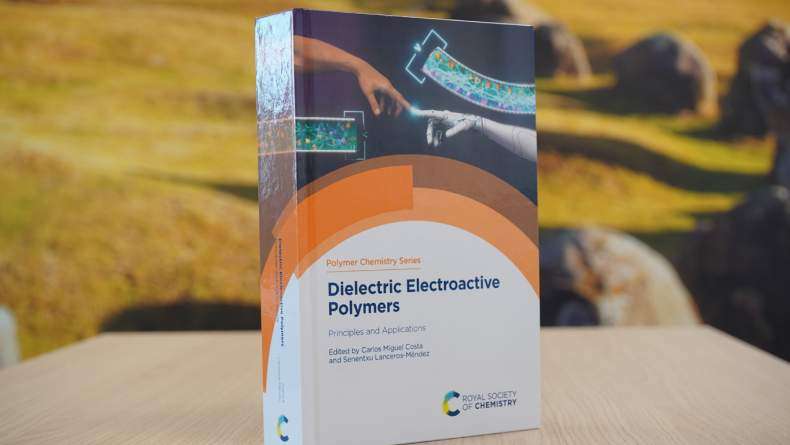
Nuevo libro de BCMaterials sobre avances en polímeros electroactivos dieléctricos
La Royal Society of Chemistry ha publicado "Dielectric Electroactive Polymers: Principles and Applications", un volumen coeditado por Senentxu Lanceros-Méndez, director científico de BCMaterials, y...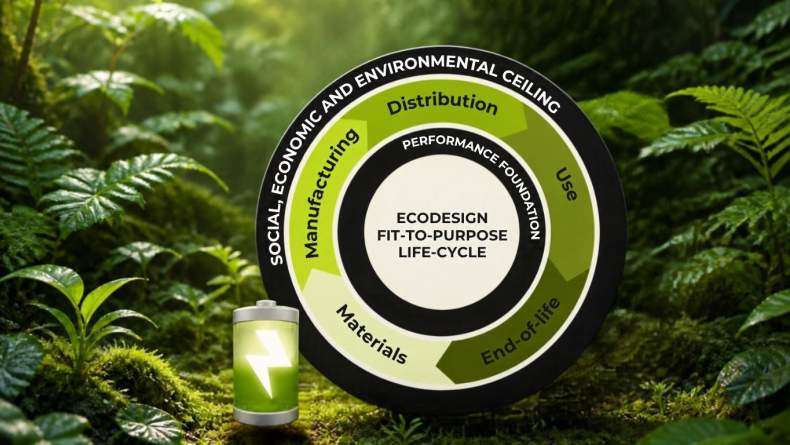
Nuevo artículo en Zientzia Kaiera: baterías portátiles respetuosas con los límites del planeta
La digitalización ha acortado la vida útil de los dispositivos y ha disparado los residuos electrónicos: 53,6 millones de toneladas en 2019, según Naciones Unidas, con una previsión de 110 millones...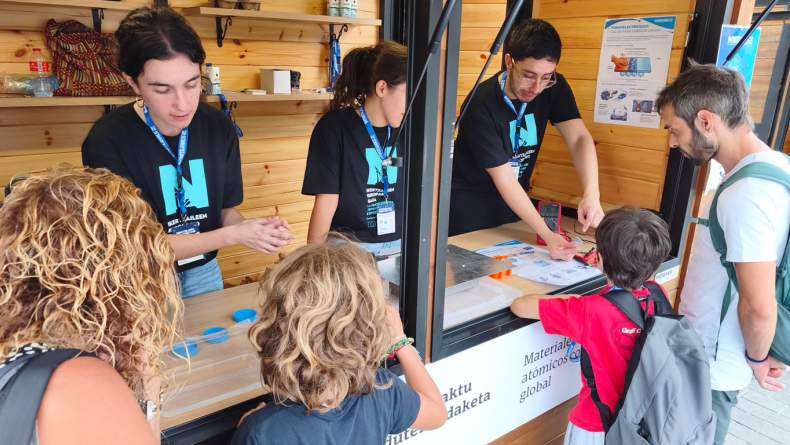
Ciencia y diversión en la Noche Europea de los Investigadores e Investigadoras de Bilbao
El pasado 25 de septiembre, BCMaterials participó en una nueva edición de la Noche Europea de los Investigadores e Investigadoras, organizada por la Universidad del País Vasco en El Arenal de Bilbao...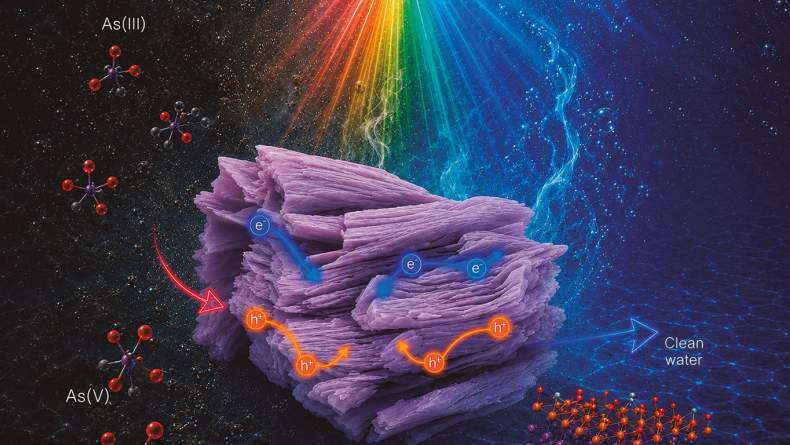
La investigación de BCMaterials, portada de Journal of Materials Chemistry A
Un estudio liderado por la investigadora de BCMaterials Maibelin Rosales, junto con Senentxu Lanceros-Méndez, Javier del Campo y Jorge Saiz, ha sido publicado en la revista Journal of Materials...